|
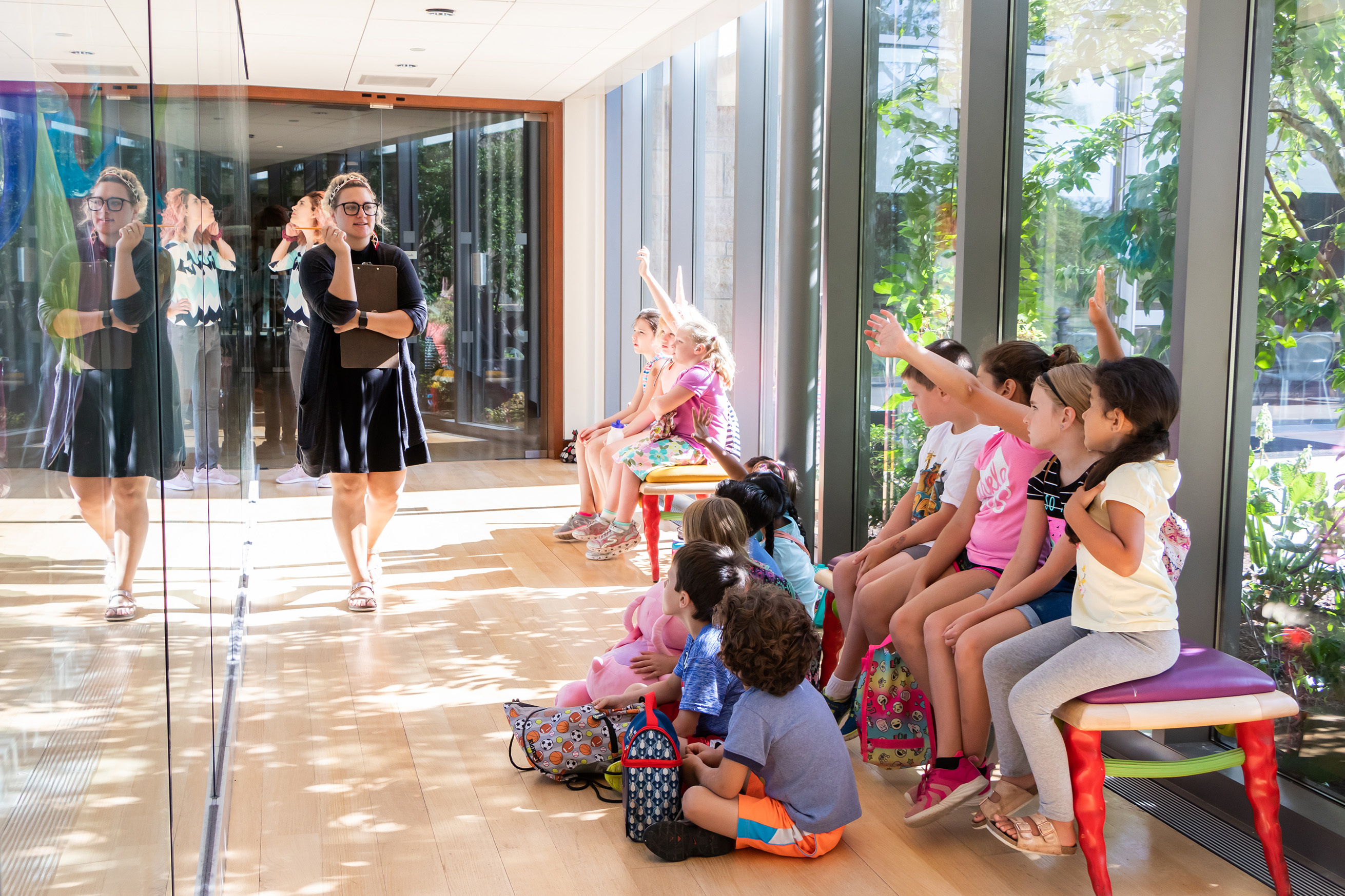
American Masterpieces Tour Sundays, 1-2 p.m., free with Museum admission. This one-hour tour, a survey of three centuries of NBMAA's masterpieces, provides a lively overview of the permanent collection from the Colonial period through today. Selections from special exhibitions may be included on the tour.
Take 20 @ 12 Fridays, noon-12:20 p.m., free with Museum admission. Join an NBMAA docent for a 20-minute smART experience to discover something new about works in the permanent collections and special exhibitions.
Wednesdays@1 | Art & Literature | Symposia | Road Scholar
WEDNESDAYS@1 Film, lecture or music at 1 p.m. Free with Museum Admission
Aug. 11: Film, The Fantastic World of M.C. Escher (50 min.) Aug. 25: Lecture with Billy Janiszewski: From Bach to Debussy Sept. 1: Film, The Life & Works of M.C. Escher (60 min.) Sept. 8: Film, The Fantastic World of M.C. Escher (50 min.) Sept. 15: Film, The Life & Works of M.C. Escher (60 min.) Sept. 22: Film, The Fantastic World of M.C. Escher (50 min.) Sept. 29: Music performance, Joy of Crystals and Polyphony in the Art of Bach, Mozart and Escher by Natasha Ulyanovsky
ART & LITERATURE Sargent’s Daughters: The Biography of a Painting by Erica Hirshler Wednesday, Aug. 18 1-3 p.m. Free with General Admission One of the most celebrated painters of his day, John Singer Sargent (1856-1925) defines for many the style, optimism and opulence of turn-of-the-century America. Among his renowned portraits, "The Daughters of Edward Darley Boit" stands alongside "Madame X" as one of Sargent's immortal images. This painting both affirms and defies convention, flouting the boundaries between portrait and genre scene, formal composition and quick sketch or snapshot. Drawing on numerous unpublished archival documents, scholar Erica E. Hirshler excavates all facets of this iconic canvas, discussing not only its significance as a work of art but also the figures and events involved in its making, its importance for Sargent's career, its place in the tradition of artistic patronage and the myriad factors that have contributed to its lasting popularity and relevance. The result is an aesthetic, philosophical and personal tour de force that will change the way you look at Sargent's work, and that both illuminates an iconic painting and reaffirms its pungent magnetism.
SYMPOSIUM The Examination of artist M.C. Escher and Composer Johann Sebastian Bach Monday, Sept. 20 10 a.m.-3 p.m. $40 members; $50 non-members (Lunch included) Learn and listen about the common themes and patterns in art of Maurits Cornelis Escher (1891-1972) and in the music of Johann Sebastian Bach (1685-1750). Did both have concepts fundamental to mathematics, symmetry, and intelligence? Escher is one of the world’s most famous graphic artists. He played with architecture, perspective, and impossible spaces. In his work we recognize his keen observation of the world around us and the expressions of his own fantasies. “To have peace with this peculiar life; to accept what we do not understand; to wait calmly for what awaits us, you have to be wiser than I am.” Bach was a German composer, organist, harpsichordist, violist, and violinist whose ecclesiastical and secular works for choir and solo instruments drew together the strands of the Baroque period and brought it to its ultimate maturity. Bach’s music was revered for his intellectual depth, technical command and artistic beauty. He was not widely recognized as a great composer until a revival of interest and performances of his music in the first half of the 19th century. He is now regarded as one of the greatest composers of all time.
Morning Program The Well Tempered Clavier by Johann Sebastian Bach, 1st Book, Part 1 performed by pianist Arthur Villar The Well Tempered Clavier, a set of 24 preludes and fugues in every major and minor key, is one of the most influential musical works ever written. Completed in 1722, the first volume of this collection was completed over the course of 20 years and finally completed in 1722. Although widely circulated through manuscript, it was not published until 1801. Bach indicated on the cover of the WTC that it was written for educational purposes, but its significance extends far beyond education. As described by German conductor and pianist Hans von Bulow, the WTC is “the old testament of western music.” Almost every great musician from the Classical tradition, including Mozart, Beethoven, Chopin, and Schumann has studied Bach’s preludes and fugues. Pianist Arthur Villar was born in Rio de Janeiro, Brazil, starting his studies in piano, chamber music, theory and conducting in 2004, at the age of 21, at the Federal University of Rio de Janeiro. One year later, Villar gave his first piano recital with The Well Tempered Clavier and since then he has been performing, with great success, the 24 preludes and fugues from the first book in several cities in Brazil, the United States and Spain. Villar considers The Well Tempered Clavier to be the synthesis of Bach’s music for keyboard, combining an unsurpassed richness of different human emotions. A work of art in the purest sense, the collection demonstrates a perfect balance between simple and complex. Tour Program Docent-led tour of the special exhibition M.C. Escher: Impossible Reality. Afternoon Programs Mathematics and the Art of M.C. Escher by Doris Schattschneider The imagery in Escher's graphic works not only makes obvious use of geometry, but often provides visual metaphors for abstract mathematical concepts. This slide lecture will reveal mathematical concepts implicit in several of Escher's works, explain the transformation geometry that he used to create his interlocking figures, and show how this "math anxious" artist actually did pioneering mathematical research in order to accomplish his artistic goals. Doris Schattschneider's dual interest in geometry and art led naturally to her study of the work of the Dutch artist M.C. Escher. She is author of the book M.C. Escher: Visions of Symmetry, coauthor of a book and collection of geometry models, M.C. Escher Kaleidocycles, and editor of a book with CD-Rom, M.C. Escher's Legacy, which contains 40 contributions by contemporary artists and others whose work has been deeply influenced by Escher. She has lectured widely on Escher's work, and has published articles in journals and in Scientific American.
How Prints are Made and Why Artists Make Them by master printmaker Anthony Kirk The lecture, with the help of demonstrations in printmaking techniques, will show how artists make prints in etching, woodcut, lithography and screenprint. Anthony Kirk will briefly describe how he developed a passion for printmaking as a student, and his career in this field for forty years during which time he collaborated as a master printer with America's most accomplished artists. Examples from his collection will demonstrate printmaking processes used by contemporary artists.
ROAD SCHOLAR The Examination of artist M.C. Escher and Composer Johann Sebastian Bach Tuesday, Sept. 21 9:30 a.m-3 p.m. Reservations must be made through Road Scholar, click here for details. Learn and listen about the common themes and patterns in art of Maurits Cornelis Escher (1891-1972) and in the music of Johann Sebastian Bach (1685-1750). Did both have concepts fundamental to mathematics, symmetry, and intelligence?
|